Data Engineering · DuckDB · ETL · Python
Querying freely available disaster response images with STAC and DuckDB
Using DuckDB, CLI to perform a quick ETL and spatial visualization
Querying Planet’s Open Data for Disasters
1. DuckDB Env setting
First, we install all the extensions:
INSTALL h3 FROM community;
INSTALL lindel FROM community;
INSTALL json;
INSTALL parquet;
INSTALL spatial;
Then we create a .duckdbrc, which is a configuration file. It loads whenever we run a query.
touch .duckdbrc
nano .duckdbrc
Then paste
bash
.timer on
.width 180
LOAD h3;
LOAD lindel;
LOAD json;
LOAD parquet;
LOAD spatial;
2. Verifying information on their bucket
We run bash sql/planet_nepal/01_check_bucket.sh to check what datasets are available.
As result, we got this output:
{
  "type": "Catalog",
  "stac_version": "1.1.0",
  "id": "disasterdata",
  "title": "Disaster Data Releases from Planet Labs PBC",
  "description": "Planet Crisis Response Program imagery for major disaster events — earthquakes, floods, storms, wildfires and human-made disasters — as a single browsable STAC / Portolan catalog. Each event is a self-contained sub-catalog with pre- and post-event high-resolution COGs (visual, pansharpened-analytic and usable-data masks), organised by affected location. Imagery © Planet Labs PBC, licensed CC-BY-NC-4.0 (non-commercial).",
  "links": [
    {
      "rel": "root",
      "href": "./catalog.json",
      "type": "application/json",
      "title": "Disaster Data Releases from Planet Labs PBC"
    },
    {
      "rel": "child",
      "href": "./nepal-flash-flood-2026-08-26/catalog.json",
      "type": "application/json",
      "title": "Planet Crisis Response — Bhote Koshi–Trishuli Outburst Flood, Nepal (2026)"
    },
    {
      "rel": "child",
      "href": "./colombia-earthquake-2026-08-10/catalog.json",
      "type": "application/json",
      "title": "Planet Crisis Response — Colombia Earthquake (2026)"
    },
    {
      "rel": "child",
      "href": "./gironde-wildfire-2026/catalog.json",
      "type": "application/json",
      "title": "Planet Crisis Response — Gironde/Landes Wildfire, France (2026)"
    },
    {
      "rel": "child",
      "href": "./venezuela-earthquake-2026-06-24/catalog.json",
      "type": "application/json",
      "title": "Planet Crisis Response — Venezuela Earthquake (2026)"
    },
    {
      "rel": "child",
      "href": "./philippines-earthquake-2026-06-08/catalog.json",
      "type": "application/json",
      "title": "Planet Crisis Response — Philippines Earthquake (2026)"
    },
    {
      "rel": "child",
      "href": "./hurricane-melissa-2025/catalog.json",
      "type": "application/json",
      "title": "Planet Crisis Response — Hurricane Melissa, Jamaica (2025)"
    },
    {
      "rel": "license",
      "href": "https://creativecommons.org/licenses/by-nc/4.0/",
      "type": "text/html",
      "title": "CC-BY-NC-4.0"
    },
    {
      "rel": "about",
      "href": "https://source.coop/planet/disasterdata/",
      "type": "text/html",
      "title": "Dataset folder & README on Source Cooperative"
    },
    {
      "rel": "describedby",
      "href": "./llms.txt",
      "type": "text/markdown",
      "title": "llms.txt (agent guide)"
    },
    {
      "rel": "icon",
      "href": "./logo-mark.png",
      "type": "image/png",
      "title": "Planet logo"
    },
    {
      "rel": "agents",
      "href": "./AGENTS.md",
      "type": "text/markdown",
      "title": "AGENTS.md (agent guide)"
    },
    {
      "rel": "describedby",
      "href": "./README.md",
      "type": "text/markdown",
      "title": "README.md"
    }
  ],
  "stac_extensions": [
    "https://schemas.portolan-sdi.org/portolan/v0.1.0/schema.json"
  ]
}
Ok, what interests me is that repository with images from Nepal. Let’s dig into it.
3. Drilling into the Nepal flood catalog
On 26 August 2026 an outburst flood swept the Bhote Koshi–Trishuli river corridor across the Nepal–China border, and Planet’s Crisis Response program released a dedicated STAC sub-catalog for it within hours. We fetch it with sql/planet_nepal/02_check_nepal_bucket.sh:
curl -s "${1:-https://data.source.coop/planet/disasterdata/nepal-flash-flood-2026-08-26/catalog.json}" \
    | jq . > "${2:-data/planet_nepal/response.json}"
bash sql/planet_nepal/02_check_nepal_bucket.sh
The catalog splits into exactly two children, which is the whole point of a crisis-response release: a before and an after.
{
  "id": "nepal-flash-flood-2026-08-26",
  "title": "Planet Crisis Response — Bhote Koshi–Trishuli Outburst Flood, Nepal (2026)",
  "links": [
    { "rel": "child", "href": "./post-event/catalog.json", "title": "Post-event imagery" },
    { "rel": "child", "href": "./pre-event/catalog.json", "title": "Pre-event baseline imagery" }
  ]
}
Each of those sub-catalogs carries an alternate link to a STAC-GeoParquet index (items.parquet). The whole point of Pattern B/C from the study guide: don’t crawl hundreds of sidecar JSON files one by one, just read the pre-built Parquet index straight off the bucket.
- Post-event:
.../post-event/items.parquet, made of three collections: PlanetScope same-day coverage (26 Aug), and two SkySat/Pelican tasked collects over Syabrubesi and Rasuwagadhi (27 Aug). - Pre-event:
.../pre-event/items.parquet, a single PlanetScope baseline collection over the same corridor from 27 May.
4. Querying the STAC-GeoParquet index directly with DuckDB
sql/planet_nepal/03_query_bucket.sql is a one-liner that was originally pointed at the Venezuela earthquake release:
SELECT
    *
FROM
    read_parquet('https://data.source.coop/planet/disasterdata/venezuela-earthquake-2026-06-24/post-event/items.parquet')
Swap the URL for the Nepal event and it works exactly the same. That’s the whole appeal of STAC-GeoParquet, every provider’s catalog collapses to the same read_parquet() call. Unioning pre- and post-event side by side gives a clean acquisition timeline without downloading a single pixel:
SELECT phase, id, collection, datetime::DATE AS acquired, platform, "eo:cloud_cover" AS cloud_pct, gsd
FROM (
    SELECT 'pre'  AS phase, * FROM read_parquet('.../pre-event/items.parquet')
    UNION ALL BY NAME
    SELECT 'post' AS phase, * FROM read_parquet('.../post-event/items.parquet')
)
ORDER BY datetime
┌─────────┬────────────────────────────┬───────────────────────────────────┬────────────┬──────────┬───────────┬────────┐
│  phase  │             id             │            collection             │  acquired  │ platform │ cloud_pct │  gsd   │
│ varchar │          varchar           │              varchar              │    date    │ varchar  │   int64   │ double │
├─────────┼────────────────────────────┼───────────────────────────────────┼────────────┼──────────┼───────────┼────────┤
│ pre     │ 20260527_053217_72_254a    │ pre-event-planetscope-2026-05-27  │ 2026-05-27 │ 254a     │        41 │    3.7 │
│ pre     │ 20260527_053219_95_254a    │ pre-event-planetscope-2026-05-27  │ 2026-05-27 │ 254a     │        43 │    3.7 │
│ pre     │ 20260527_053221_96_254a    │ pre-event-planetscope-2026-05-27  │ 2026-05-27 │ 254a     │        52 │    3.7 │
│ pre     │ 20260527_053224_18_254a    │ pre-event-planetscope-2026-05-27  │ 2026-05-27 │ 254a     │        48 │    3.7 │
│ pre     │ 20260527_053226_41_254a    │ pre-event-planetscope-2026-05-27  │ 2026-05-27 │ 254a     │         5 │    3.7 │
│ post    │ 20260826_050125_99_255f    │ post-event-planetscope-2026-08-26 │ 2026-08-26 │ 255f     │        79 │    3.8 │
│ post    │ 20260826_050128_33_255f    │ post-event-planetscope-2026-08-26 │ 2026-08-26 │ 255f     │        78 │    3.8 │
│ post    │ 20260826_050130_66_255f    │ post-event-planetscope-2026-08-26 │ 2026-08-26 │ 255f     │        93 │    3.8 │
│ post    │ 20260826_050133_00_255f    │ post-event-planetscope-2026-08-26 │ 2026-08-26 │ 255f     │        92 │    3.8 │
│ post    │ 20260826_050135_34_255f    │ post-event-planetscope-2026-08-26 │ 2026-08-26 │ 255f     │        62 │    3.8 │
│ post    │ 20260826_054456_67_251f    │ post-event-planetscope-2026-08-26 │ 2026-08-26 │ 251f     │        72 │    3.4 │
│ post    │ 20260826_054458_74_251f    │ post-event-planetscope-2026-08-26 │ 2026-08-26 │ 251f     │        88 │    3.4 │
│ post    │ 20260826_054500_80_251f    │ post-event-planetscope-2026-08-26 │ 2026-08-26 │ 251f     │        92 │    3.4 │
│ post    │ 20260826_054502_86_251f    │ post-event-planetscope-2026-08-26 │ 2026-08-26 │ 251f     │        78 │    3.4 │
│ post    │ 20260827_020055_ssc1_u0001 │ post-event-skysat-2026-08-27      │ 2026-08-27 │ SSC1     │        50 │   0.81 │
│ post    │ 20260827_020055_ssc1_u0002 │ post-event-skysat-2026-08-27      │ 2026-08-27 │ SSC1     │        50 │   0.79 │
│ post    │ 20260827_060956_98_3009    │ post-event-pelican-2026-08-27     │ 2026-08-27 │ 3009     │        85 │   0.55 │
│ post    │ 20260827_060958_31_3009    │ post-event-pelican-2026-08-27     │ 2026-08-27 │ 3009     │        83 │   0.55 │
│ post    │ 20260827_060959_65_3009    │ post-event-pelican-2026-08-27     │ 2026-08-27 │ 3009     │        85 │   0.55 │
└─────────┴────────────────────────────┴───────────────────────────────────┴────────────┴──────────┴───────────┴────────┘
  19 rows                                                                                                     7 columns
Two things jump out. First, cloud cover on the PlanetScope pass over the actual flood day (26 Aug) is brutal, between 60-90%. Second, the tasked SkySat/Pelican collects that came in a day later have sub-metre gsd (0.55-0.81 m against 3.4-3.8 m for PlanetScope).
5. Turning the catalog into a GeoParquet + map with Python
sql/planet_nepal/get_planet_stac_data.py is the reusable pipeline behind all of this. It doesn’t hardcode Nepal, Venezuela or any single provider, it takes any STAC Catalog or Collection URL and:
- loads it with
pystac(load_catalog), - walks every item recursively (
collect_items), - tags each geometry
pre/postfrom its STAC lineage, falling back to the event date parsed out of the catalog title/description when lineage alone isn’t enough (classify_phase), - writes the result to GeoParquet (
save_parquet), - and renders a UNOSAT-style satellite map; geometries colored by phase or by exact acquisition date, plus a small world-locator inset over Esri World Imagery (
plot_event_map).
def run(url: str, parquet_path: Path, map_path: Path) -> gpd.GeoDataFrame:
    """End-to-end: load a catalog, classify, export, and plot."""
    catalog = load_catalog(url)
    event = extract_event_info(catalog)
    gdf = items_to_gdf(collect_items(catalog))
    gdf = classify_phase(gdf, event)

    save_parquet(gdf, parquet_path)
    plot_event_map(gdf, event, map_path)
    return gdf
Pointing it at Planet’s Nepal catalog root gives 19 footprints (5 pre-event, 14 post-event) and this map:
The cyan footprints are the 27 May PlanetScope baseline, the purple ones are the 26 Aug same-day PlanetScope pass, and the tight magenta cluster is the 27 Aug SkySat/Pelican tasking; visibly much smaller and much more tightly targeted on the actual river corridor, which lines up with the sub-metre gsd we saw in the query above.
6. Cross-checking against a second, independent provider
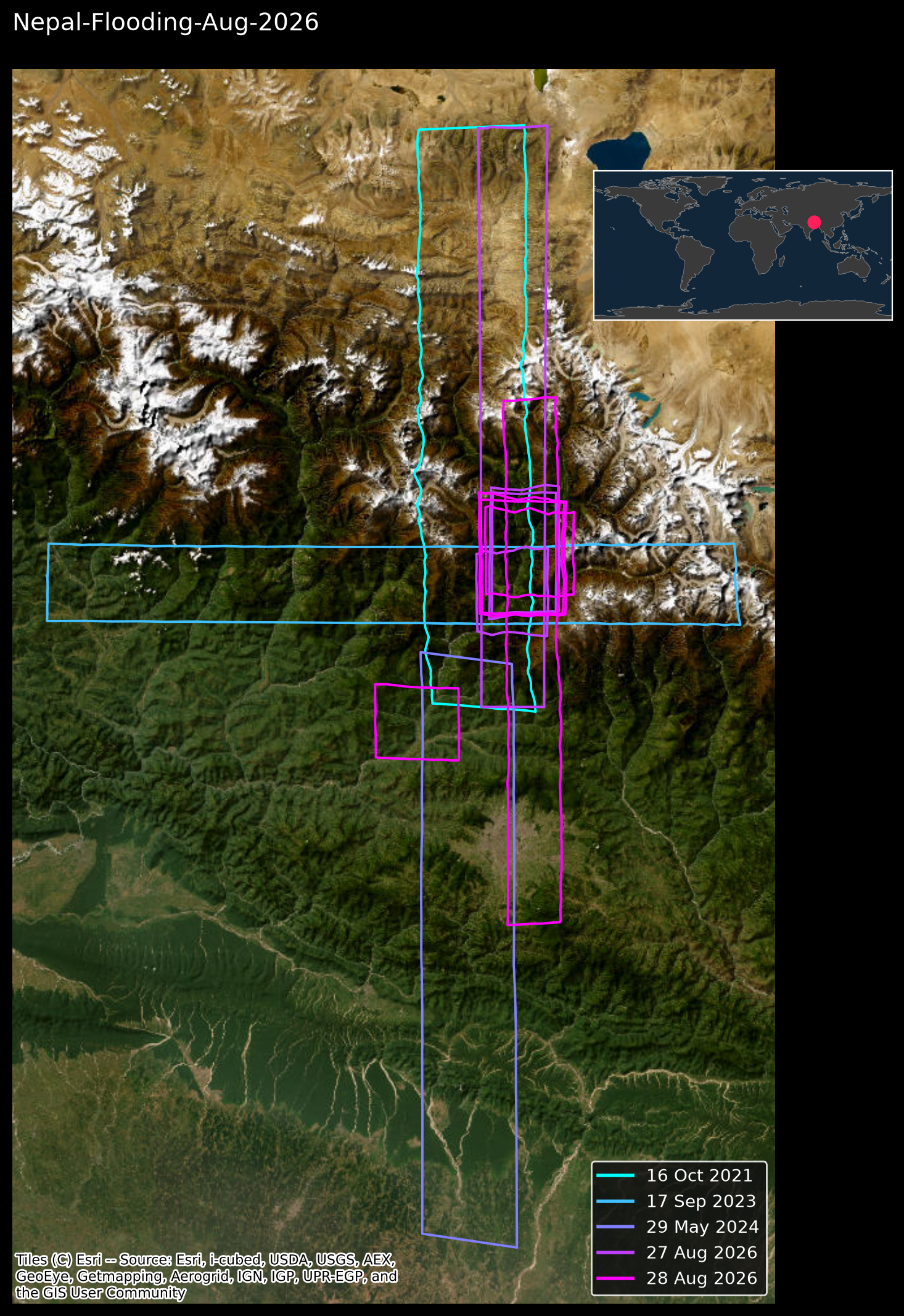
Planet isn’t the only open feed with eyes on this event. Vantor (Maxar’s open disaster-imagery bucket, vantor-opendata) publishes its own STAC Collection for the same flood at events/Nepal-Flooding-Aug-2026/collection.json — no pre-computed GeoParquet index, no pre/post sub-catalogs, just a flat collection of tasked scenes. Since get_planet_stac_data.py only cares that a URL resolves to some STAC container, the exact same script runs against it unchanged:
python sql/planet_nepal/get_planet_stac_data.py # URL swapped to the Vantor collection
This is a good example of why “classify by lineage, fall back to date” isn’t a nicety but a necessity: Vantor’s collection has no pre-event/post-event sub-folders to inherit a phase from, and its description spells the date out as “August 26, 2026” instead of the 26 Aug 2026 / ISO forms the date-parser recognizes, so every footprint falls through to unknown phase, and the plotting code automatically drops into its date-colored fallback instead. It also surfaces something Planet’s curated release doesn’t show: Vantor’s archive reaches back to 16 October 2021, and that oldest footprint is a wide swath sitting mostly west of the flood corridor, leftover coverage from an unrelated earlier tasking, not disaster response. It’s a reminder that a raw provider bucket is an archive, not a curated crisis package, and a real pipeline has to filter for relevance itself rather than trust that everything returned is on-topic.
Sources & Inspiration
This was shaped by working through Mark Litwintschik’s approach to treating big open datasets as “just a table,” applied here to STAC/GeoParquet.